
TM30 & 90-Day Report Explained: A Complete Guide for Foreigners in Thailand
90 day report is one of the most important immigration requirements for foreigners staying in Thailand long term. If you are living in Thailand on a retirement visa, marriage visa, business visa, education visa, or other long-term visa category, understanding the 90 day report process is essential for maintaining legal immigration status.
If you are living in Thailand on a long-term visa, understanding immigration compliance is essential. Two of the most important requirements for foreign residents are the TM30 notification and the 90 day report. While both are required by Thai immigration authorities, many foreigners often confuse the two processes.
Failing to complete a TM30 filing or a 90 day report can result in fines, delays in visa renewals, and other immigration complications. Whether you are a retiree, business visa holder, student, dependent, or digital nomad, understanding these requirements will help you stay compliant while living in Thailand.
This guide explains everything you need to know about TM30 registration, the 90 day report, who must file them, deadlines, penalties, and how professional visa services can help simplify the process.
สารบัญ
- What Is a 90 Day Report?
- Who Must Submit a 90 Day Report?
- What Is TM30?
- Who Must File a TM30?
- TM30 vs 90 Day Report: What's the Difference?
- TM30
- 90 Day Report
- When Is a TM30 Required?
- When Must You Submit a 90 Day Report?
- How to Submit a 90 Day Report
- 1. Online 90 Day Report
- 2. Immigration Office Submission
- 3. Authorized Representative
- 4. Professional Visa Service
- Penalties for Missing a 90 Day Report
- Common TM30 and 90 Day Report Mistakes
- Assuming TM30 Replaces a 90 Day Report
- Forgetting After Overseas Travel
- Not Updating a New Address
- Missing Deadlines
- Why Immigration Compliance Matters
- Benefits of Professional TM30 and 90 Day Report Services
- Frequently Asked Questions
- Is a 90 day report required for all foreigners?
- Does leaving Thailand reset the 90 day report?
- Is TM30 the same as a 90 day report?
- Can I submit a 90 day report online?
- Can someone submit a 90 day report for me?
- How DEVI Visa Can Help
What Is a 90 Day Report?
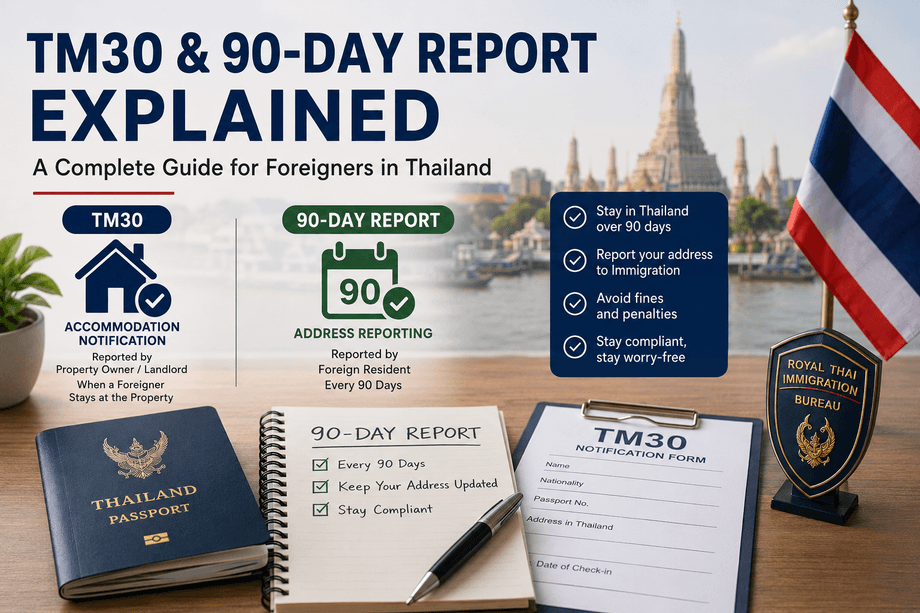
A 90 day report is a mandatory immigration requirement for foreigners who stay in Thailand continuously for more than 90 days.
The purpose of the 90 day report is to notify Thai Immigration of your current residential address. It is not a visa extension and does not affect your visa validity. Instead, it is simply an address confirmation required by immigration law.
Every foreigner staying in Thailand for more than 90 consecutive days must submit a 90 day report to the Immigration Bureau.
The countdown begins from the day you enter Thailand or from the date of your previous report.
Who Must Submit a 90 Day Report?
A 90 day report is generally required for:
Retirement visa holders
Business visa holders
Marriage visa holders
Education visa holders
Dependent visa holders
Long-Term Resident (LTR) visa holders
Other long-stay visa holders
If you remain in Thailand continuously, you must continue submitting a 90 day report every 90 days throughout your stay.
What Is TM30?
TM30 is a separate immigration requirement that involves reporting the residence of a foreign national.
Under Thai immigration regulations, the property owner, landlord, hotel operator, or host must notify immigration whenever a foreigner stays at their property.
This notification is submitted using Form TM30.
The TM30 system allows immigration authorities to maintain records of where foreign nationals are residing throughout Thailand.
Unlike a 90 day report, TM30 focuses on accommodation registration rather than periodic address confirmation.
Who Must File a TM30?
TM30 filing is typically the responsibility of:
Property owners
Landlords
Hotel operators
Apartment managers
Hosts accommodating foreigners
However, many foreigners are still asked to ensure that their TM30 has been properly submitted, especially when applying for:
Visa extensions
Re-entry permits
Immigration services
Certain visa conversions
For this reason, foreign residents should always verify that their TM30 registration is current.
TM30 vs 90 Day Report: What's the Difference?
One of the most common immigration questions is understanding the difference between TM30 and a 90 day report.
TM30
TM30 is:
Accommodation registration
Filed when a foreigner stays at a property
Usually submitted by the property owner
Triggered when moving to a new residence
90 Day Report
A 90 day report is:
Personal immigration reporting
Submitted every 90 days
Filed by the foreign resident
Required even if the address does not change
In simple terms, TM30 reports where you live, while a 90 day report confirms that you are still living there after 90 days.
When Is a TM30 Required?
A TM30 filing may be required when:
Arriving at a new residence
Returning from overseas travel
Moving to a different condominium
Changing apartments
Staying at a hotel
Relocating to another province
Immigration officers may request TM30 evidence during visa-related applications.
Keeping TM30 records up to date can prevent complications later.
When Must You Submit a 90 Day Report?
The 90 day report must be submitted every 90 consecutive days of stay in Thailand.
Immigration generally allows filing:
Up to 15 days before the due date
Up to 7 days after the due date (depending on reporting method)
Missing the deadline can result in fines.
It is advisable to track your report schedule carefully to avoid penalties.
How to Submit a 90 Day Report
There are several methods for submitting a 90 day report.
1. Online 90 Day Report
Many foreigners prefer the online 90 day report system.
Benefits include:
No travel required
Faster processing
Convenient submission
Available from anywhere in Thailand
However, the online system may occasionally experience technical issues.
2. Immigration Office Submission
You may visit your local Immigration Office and submit your 90 day report in person.
Required documents typically include:
Passport
Previous reporting receipt
Immigration forms
3. Authorized Representative
An authorized representative may submit a report on your behalf.
This option is popular among retirees and business travelers.
4. Professional Visa Service
Many foreigners choose professional visa agencies to handle their 90 day report and immigration compliance requirements.
This reduces the risk of missed deadlines and paperwork errors.
Penalties for Missing a 90 Day Report
Failure to submit a 90 day report can result in fines and immigration complications.
Common consequences include:
Financial penalties
Delays during visa renewals
Additional immigration scrutiny
Administrative complications
If immigration discovers that a required report was not submitted, penalties may increase.
Submitting reports on time helps avoid unnecessary issues.
Common TM30 and 90 Day Report Mistakes
Foreigners often make mistakes regarding TM30 and 90 day report requirements.
Assuming TM30 Replaces a 90 Day Report
TM30 and a 90 day report are separate requirements.
Completing one does not eliminate the need for the other.
Forgetting After Overseas Travel
When re-entering Thailand, your report timeline resets based on your new entry date.
Many foreigners mistakenly continue counting from their previous report.
Not Updating a New Address
Moving to a new residence may require TM30 updates.
Failure to update records can cause immigration issues later.
Missing Deadlines
One of the most common mistakes is simply forgetting a 90 day report deadline.
Calendar reminders can help prevent this problem.
Why Immigration Compliance Matters
Thai immigration regulations continue to evolve, making compliance increasingly important.
Proper management of:
TM30 registration
Visa renewals
Re-entry permits
90 day report obligations
helps ensure a smooth immigration experience.
Immigration officers may review compliance history when processing future applications.
Maintaining accurate records demonstrates responsible residency in Thailand.
Benefits of Professional TM30 and 90 Day Report Services
Many foreigners prefer professional assistance to avoid administrative errors.
Professional services can help with:
TM30 filing
90 day report submission
Immigration reminders
Visa extension support
Documentation preparation
Compliance monitoring
These services are especially useful for retirees, business owners, and individuals who travel frequently.
Frequently Asked Questions
Is a 90 day report required for all foreigners?
A 90 day report is required for foreigners who remain in Thailand continuously for more than 90 days under eligible visa categories.
Does leaving Thailand reset the 90 day report?
Yes. When you leave Thailand and re-enter, the 90 day report count generally starts again from your latest entry date.
Is TM30 the same as a 90 day report?
No. TM30 and a report are different immigration requirements with different purposes.
Can I submit a 90 day report online?
In many cases, yes. The online report system is available for eligible applicants.
Can someone submit a 90 day report for me?
Yes. An authorized representative or professional visa service can often assist with your report submission.
How DEVI Visa Can Help
Understanding TM30 regulations and managing every 90 day report can be confusing, especially for foreigners unfamiliar with Thailand's immigration system.
DEVI Visa provides comprehensive immigration compliance services, including:
TM30 filing assistance
90 day report submission
Visa renewal support
Retirement visa services
Business visa services
Immigration consultation
Our experienced team helps ensure your immigration records remain accurate and compliant, allowing you to focus on enjoying your life in Thailand.
Both TM30 registration and the report are essential parts of living legally in Thailand. Although they serve different purposes, they work together to help Thai Immigration maintain accurate records of foreign residents.
Understanding when to file a TM30, when to submit a report, and how to stay compliant can save you from fines, delays, and unnecessary stress. Whether you are a retiree, investor, employee, student, or long-term resident, keeping up with your immigration obligations is an important part of living in Thailand.
If you need assistance with your next 90 day report, TM30 filing, or any other immigration matter, DEVI Visa is ready to help make the process simple, efficient, and worry-free.
Related blog